Opening comparative frame
Designing a tactical FPV system demands choices that ripple across payload, range, and mission reliability. On one axis sits synchronous target tracking—tight timing between sensors and flight control; on the other, multi-threat discrimination—classifying and prioritizing incoming signals. Practical designs increasingly favor coaxial layouts for compact torque control; see coaxial drones for platform examples. My approach is analytical and sustainability-minded: I weigh sensor fusion, power consumption, and mechanical simplicity together rather than in isolation.

Tracking architectures compared
Two dominant architectures appear in the field. Centralized synchronization routes raw sensor streams to a single compute node that runs target tracking and SLAM concurrently. It simplifies state estimation but raises a single-point-of-failure and higher peak power draw. Decentralized tracking shards compute across embedded nodes—one processor handles gimbal stabilization and optical flow while another handles classifier outputs. That lowers worst-case thermal load and often extends flight time, but it complicates latency budgets and synchronization protocols.
Discrimination strategies and their trade-offs
Multi-threat discrimination combines radar cross-section cues, RF signature matching, and visual classifiers to triage threats. Classic machine-vision classifiers are fast but brittle under low light and smoke; integrating thermal imaging stabilizes results at the expense of weight and energy. Sensor fusion remains the practical bridge: lightweight IMU-assisted visual processing reduces false positives while preserving a small computational footprint. The sustainability angle matters—each additional sensor adds weight, which increases energy per kilometer and shortens loiter time.
Platform implications—power, weight, and control
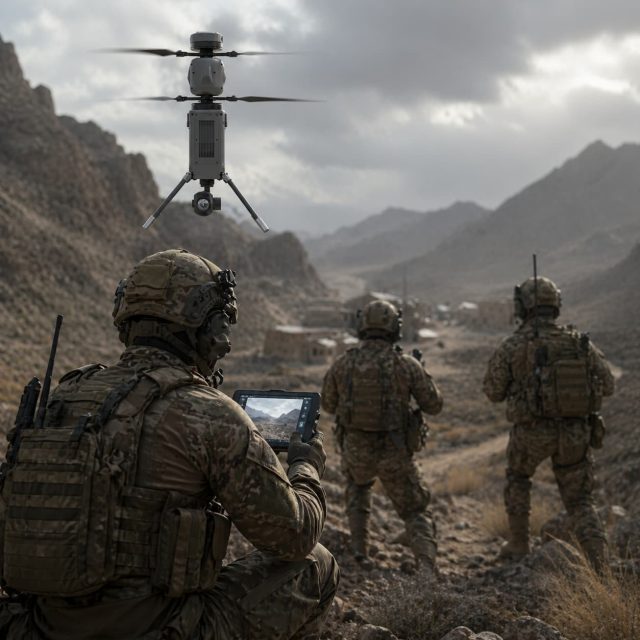
Choice of airframe changes the math. A coaxial dualrotor design compacts lift into a smaller envelope and reduces rotor diameter, cutting transport footprint and enabling denser payload mounting. See how this plays out in field reports from the 2022 Ukraine conflict, where small FPV systems showed how compact platforms can deliver effective reconnaissance under contested conditions. But compactness raises thermal and vibration challenges for compute units—plan for thermal throttling and hardened gimbal stabilization. SLAM pipelines must be tuned to available CPU headroom, not theoretical throughput.
Common design mistakes to avoid
Teams often over-spec sensors for detection without matching compute or power capacity; the result is a heavier drone with poor endurance. Another recurring error is assuming line-of-sight (LOS) communications will hold—real missions include urban canyons and GPS-denied zones. Resilient systems provision degraded modes: local tracking on-board, reduced-rate telemetry, and a clear handover when control links drop. When integrating perception stacks, align classifier confidence thresholds to mission risk rather than to bench accuracy—this lowers false engagement rates without inflating operator workload. —A small calibration step can save a mission.
Implementation checklist and alternatives
Prioritize modularity: separate sensor buses, independent processors for flight control and perception, and a graceful fallback state. Consider alternatives: tilt-rotor hybrids for higher cruise efficiency, or micro fixed-wing scouts for range; coaxial dualrotor drone layouts remain attractive where vertical agility and compact packing matter. For endurance gains, optimize propulsive efficiency and battery thermal management rather than adding marginal sensors that demand disproportionately more power.
Advisory — three golden rules for selection
1) Match compute to mission: choose synchronization schemes that keep worst-case latency below your target-tracking loop rate, and budget for thermal throttling. Sensor fusion works only if processing capacity sustains it.
2) Budget energy per feature: assign a watts-per-kilogram cost to each sensor and algorithm. Prioritize features that improve discrimination without doubling the power draw—sustained endurance wins more missions than flashy short bursts.

3) Design for degraded modes: ensure on-board local tracking and a minimal classifier can continue without LOS or full GNSS. Redundancy in perception beats single high-accuracy sensors when conditions degrade.
These rules point to the pragmatic value of compact, efficient platforms and open the door to the curated content and platform analyses available at Military Hub. —Measured, tested, and ready for field decisions.